Capturing the Black Badge: HackspaceCon Phone Phreaking CTF
Some CTFs are you and a laptop. This one was me, a friend, a wall of old telephone wiring, and a pair of alligator clips. It’s still one of the most unique competitions I’ve ever done — and we walked away with 1st place and a Black Badge.
Finding a Teammate
Here’s a funny one: I’ve only ever been to a single UFSIT meeting — UF’s student infosec club, a few hours up the road — but that one visit is what won me this competition. That’s where I met the guy who’d end up being my teammate. When we crossed paths again at HackspaceCon a while later, I jumped on his phone phreaking CTF team without hesitation. Half of doing well in this scene is just finding the right people to nerd out with, and one random meeting turned out to be exactly that.
The CTF was hosted by John Aff (a.k.a. Panda), and it was unlike anything I’d walked into before.
An Actual Bell System
Instead of a web portal and a scoreboard, the challenge was a physical, intricately wired telephone network — real old phone lines and hardware built to recreate the classic Bell System. Rows of punch-down blocks (the 66-block frames you’d find in an old telco closet), a wall-mounted red payphone, a canvas Bell System lineman’s bag, and a pile of orange and blue lineman’s handsets — butt sets — for clipping into the lines. It was the kind of analog infrastructure most of us have only read about.
The goal was to connect your clamps to the right wires, work through the network, and find the audio clip that answered each question. You were literally listening your way through the puzzle. Every correct connection was a little hit of dopamine — you’d clip in, hear a tone or a voice, and realize you’d just pulled a signal out of a tangle of copper by hand.
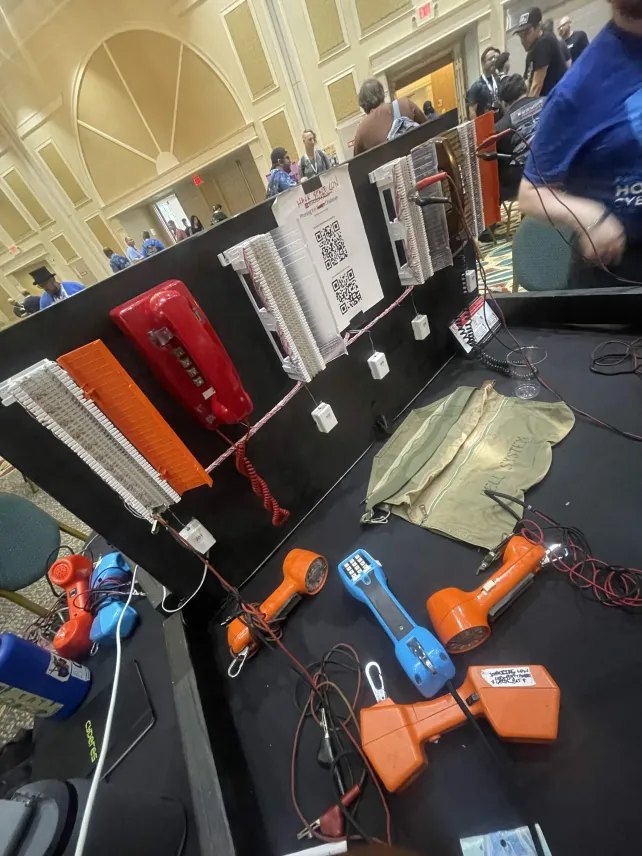 The actual rig: 66-block punch-down frames wired across the board, a red wall payphone, a QR-coded challenge sheet, a canvas Bell System lineman’s bag, and the pile of orange and blue butt sets we clipped in with.
Why It Stuck With Me
What made this one special wasn’t just the win. It was learning a whole slice of history I’d never touched. Phreaking is where a lot of hacker culture actually started, and working through that board gave me a real appreciation for the people who figured this stuff out with nothing but curiosity and a butt set. We picked up a ton of DEFCON lore along the way from the folks running and hanging around the challenge, the kind of stories that don’t make it into any course.
The Part I Didn’t See Coming: The Speech
Here’s the thing nobody warned me about — at the end, they had me get up and give a little speech about my experience. Me, in front of everyone, suddenly the guy talking. I’m not going to pretend I had it scripted lol. I just talked about what the challenge was actually like: clipping into a live network by hand, the rush of hearing the right clip come through, and how much fun it was learning this old-school side of hacking I’d never touched before. Slightly nervous, definitely not rehearsed, but it was a cool moment to stand up and share what made it click for us. Turns out winning the badge came with a mic.
Wrapping Up
Winning first place and earning the Black Badge was incredible. But honestly, the part I keep telling people about is the feeling of clipping into a live phone network and hearing it answer back (and, apparently, giving an impromptu speech about it afterward). Highly recommend chasing down the weird, hands-on CTFs when you can — they teach you things the polished ones can’t.
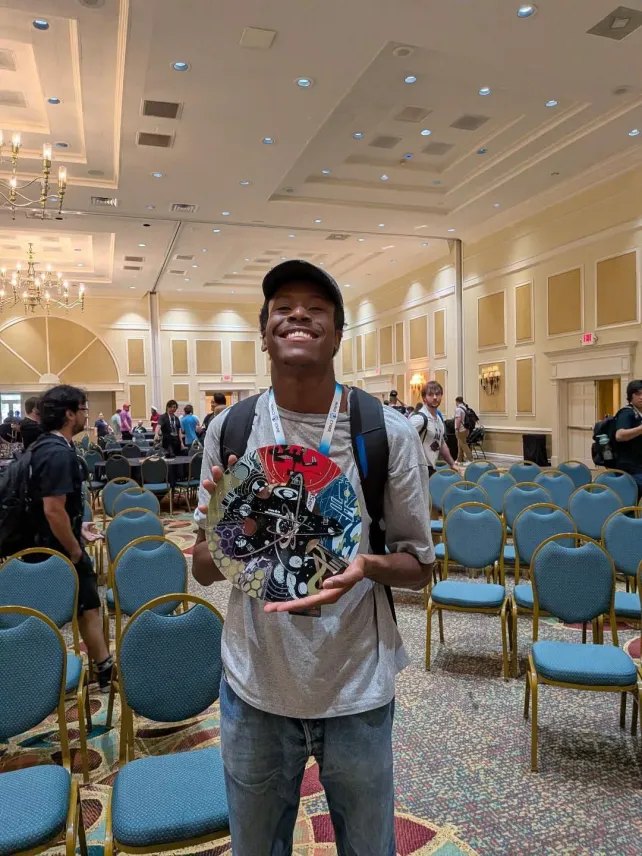 Badge in hand in the emptying ballroom — worth every clip and crossed wire.