More Than Flags: Building a Career Pipeline at FAU
Competitions get the highlight reel, but they were never the whole point for me. When I stepped up from Vice President to President of the FAU Cybersecurity Club, the goal I cared about most wasn’t a placement on a scoreboard — it was getting my members into internships and real careers. Flags are fun. Watching someone land their first security role is better.
Turning Practice Into Employability
The single most valuable thing we do as a club, in my opinion, is our weekly system hardening workshops. Every week I’d walk members through STIG-style hardening — the actual, hands-on skill of taking a vulnerable system and locking it down properly. It’s competition prep, sure, but it’s also exactly the kind of thing that shows up in a SOC or a sysadmin role on day one.
That’s the connection I kept trying to make explicit for everyone: the stuff we practice for CCDC is the stuff that gets you hired.
Bringing the Industry to Us
You can only teach so much from inside a club room, so I made it a mission to bring professionals in to speak about their experience and, more importantly, how to actually break into cyber.
I was lucky enough to host some genuinely incredible people:
- Delia Drumm from Microsoft, who shared her path and what the industry looks like from inside one of the biggest tech companies in the world.
- Carl Froggett, who spent roughly 20–30 years as a CISO at Citi and is now the CIO of Deep Instinct. Getting someone with that level of experience to sit down with a room full of students is not something I take for granted.
- Dwight Goins from JM Family, who I actually met at a career fair. I got him and his daughter to come in and speak together about their experience and expertise with AI — a really cool cross-generational take on where the field is heading.
- Pedro Cartagena from our own school’s security team. He gave an amazing presentation on digital forensics and Splunk, walked us through how to actually break into DFIR, and showed us how to stand up a homelab. He’s genuinely passionate about all things IT and had the funny stories to keep the whole room hooked.
I also brought in local companies I’d personally interviewed with. One of my favorites was Wade from NCCI, their infrastructure and security manager — he brought his entire team, plus their intern, to come speak about all things cyber.
That one was a funny full-circle moment. I met Wade and his team through an interview. I didn’t get the role… but I got the connection, and honestly that’s better. That relationship turned into a whole panel of professionals coming to talk to my club. Sometimes the “rejection” is just the start of something more useful.
Building Direct Pipelines
The guest speakers open doors, but the best outcome is when the club becomes a genuine pipeline into companies.
That’s exactly what happened at the end of my internship at Arete. A fellow club member and I did well enough there that we were able to recommend other people from our club for interviews — creating a direct line from our little club room straight into a real security company. There’s no better feeling than knowing the work you put in opened a door not just for you, but for the people coming up behind you.
That experience changed how I thought about my role as President. It wasn’t enough to bring professionals in to speak — I wanted to be the connection myself. So I started being intentional about it: building relationships at the companies I worked for, making sure the right people knew the club existed, and being in a position to put names forward when opportunities came up.
That work is ongoing. Right now I actively have a way to get club members into cybersecurity internship interviews. Not hypothetically — there is a real path, and it runs through the club. That’s what I want members to know when they join: it’s not just workshops and competitions. Show up, put in the work, and there are people in your corner who can open actual doors.
Making Friends Across Clubs
A lot of our growth didn’t come from inside FAU at all — it came from showing up to other schools’ clubs, showing genuine interest, and making friends.
- Cal Poly Swift (Cal Poly Pomona) has become one of our closest connections — a big, well-run club we’ve leaned on for competitions and bootcamps. Genuinely fun, welcoming people who are a pleasure to work with. (They’re also the crew behind the Purple Team KOTH I wrote up.)
- UFSIT (University of Florida) — I drove up to sit in on one of their meetings in person and learned a ton about what a bigger club can offer. That single visit ended up paying off in a way I never saw coming (more on that in my phone phreaking write-up).
- HackUCF — hands down one of our biggest friends in the state. They’re always down to give us advice, and having a club like that in your corner makes everything easier.
Making these friendships is honestly half the point. The collegiate cyber community in Florida is small enough that a few good connections open doors to competitions, tips, and opportunities you’d never find on your own.
Bridges On Campus and in the Community
Closer to home, some of our best growth came from reaching across our own campus and into the local scene. I guest-spoke at FAU’s Management Information Systems Association (MISA) to pull in students who didn’t even know cyber was an option for them, and collaborated with SHPE members on joint initiatives to widen who we reach.
Beyond campus, I worked to expand our partnerships with organizations like SFISSA and HackMiami — plugging our members into the broader South Florida security community where the internships, mentors, and opportunities actually live.
The Real Mission
At the end of the day, a club is a pipeline. Competitions sharpen the skills, the workshops make them job-ready, the guest speakers and partnerships build the network, and the whole thing funnels toward one outcome: members leaving with careers, not just war stories. That’s the version of “winning” I care about most — and it’s the part of this role I’ll always be proud of.
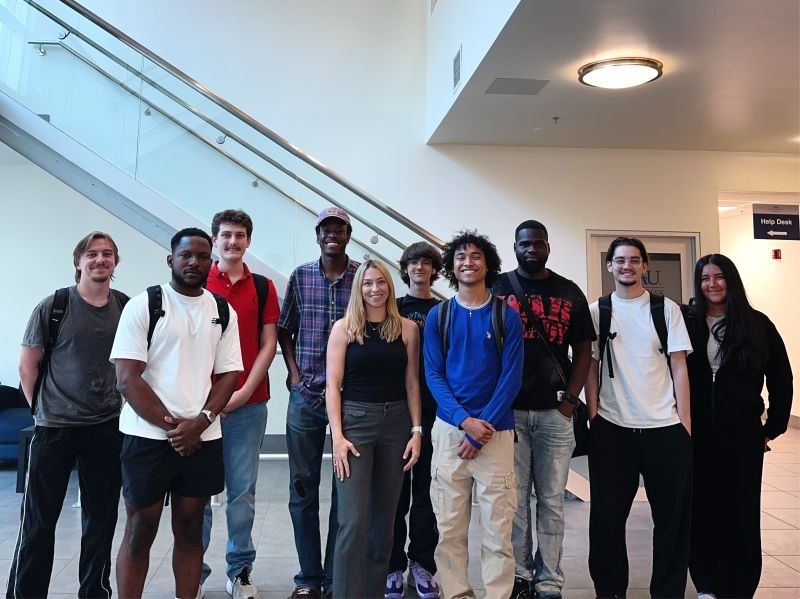 The club turned out for our guest-speaker series — this was the session bringing in Delia Drumm from Microsoft.
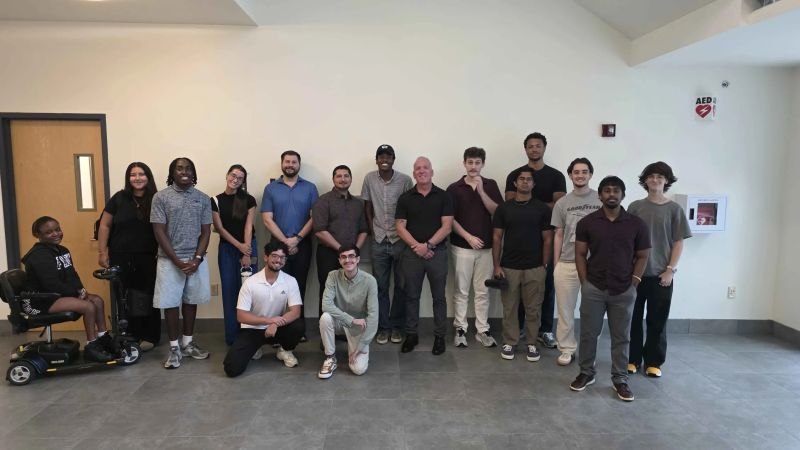 Wade from NCCI lined up his entire team (and their intern) against the wall to come speak — the full-circle connection I made through an interview I didn’t even get.